
This essay is written in both English and Lithuanian — lietuviškas tekstas žemiau.
Fabric Is Never Just Fabric
Fabric is never just fabric.
Every piece of cloth already carries a history.
It once lived a life — covered someone’s bed, warmed someone’s shoulders, touched their knees, absorbed sweat, witnessed tears of joy, heard their sorrows. Maybe it lay folded in a closet, waiting. Maybe it was loved. Maybe it was forgotten.
When I take that fabric into my hands, its story becomes part of mine.
I love touching natural materials — linen, cotton. They are part of nature, just as we are.
It all began with scraps.
Small pieces of fabric that I lay side by side, turn, cut into, stitch. Sometimes very seriously. Sometimes playfully.
And at some point, they become one.
I don’t start with a blank canvas.
I start with what was already there.
People have joined and stitched scraps together in different parts of the world.
In the Sufi tradition, wandering ascetics wore patched cloaks stitched from pieces of cloth. In Korea, women created jogakbo — patchwork made from small fabric remnants and used to wrap gifts and everyday objects.
In Lithuania, too, scraps of fabric and pieces of worn clothing were stitched together into patchwork — bedspreads, covers, objects made for everyday life.
Different countries. Different histories. And yet, in all of them, I see the same human gesture — don’t throw away. Preserve. Stitch together. Let it live on.
Patchwork doesn’t pretend to be perfect.
It remembers. It says:
here is what remained.
It doesn’t hide its seams, its threads.
On the contrary — they are part of its story.
It isn’t whole, because life isn’t whole either. It is made of separate moments — beautiful, uncomfortable, funny, painful, sometimes seemingly insignificant.
But placed side by side, they don’t become chaos.
They become a map.
A map of lives already lived, holding many stories at once.
Stitched together so they can remain.
Maybe that’s why, when I touch an old piece of fabric, I feel more than one life.
I feel my own, too.
Like one more patch already being stitched — through my daughters — into some future fabric of humanity that I myself will never see.
And a thought comes to me:
each of us is like a thread.
One thread alone is fragile. Easy to break.
But woven together, we become fabric.
We become stronger.
We can hold each other.
Maybe that’s why fabric, for me, isn’t simply a material for making a painting.
It is a language.
The past intertwines with the present. Someone else’s story with mine. Nature with human hands. Someone’s worn shirt with my stitch. My life with the life of someone I may never meet.
And I take these fabrics — I sew, cut, talk to them, play with them, fool around.
And they live on.
They become a painting.
A painting with a language of its own. One that will someday find someone with whom it can continue the conversation.
Maybe it will bring beauty into a room. Maybe it will comfort. Maybe it will encourage someone to keep going. Maybe someone will walk past it a hundred times, and only on the hundred-and-first will they suddenly see something.
Because art has its own quiet power.
A quiet language — simply to be near.
To be.
⸻
🇱🇹 Lietuviškai
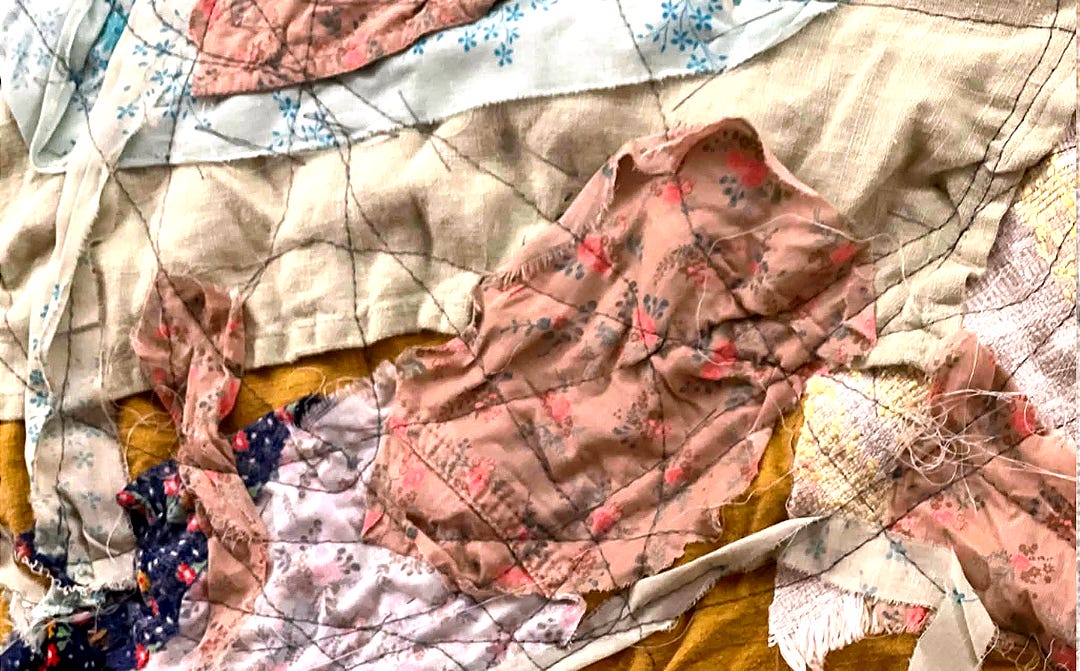
Audinys – ne tik audinys
Audinys nėra tik audinys.
Kiekvienas audinys jau turi savo istoriją.
Jis kažkada gyveno gyvenimą — dengė kažkieno lovą, šildė pečius, lietė kelius, sugėrė prakaitą, matė džiaugsmo ašaras, girdėjo godas. Gal gulėjo spintoje ir laukė. Gal buvo mylimas. Gal pamirštas.
Kai paimu tą audinį į rankas, jo istorija tampa ir mano istorija.
Kaip gera liestis prie natūralių medžiagų — lino, medvilnės. Jos — gamtos dalis, kaip ir mes.
Viskas prasidėjo nuo skiautinių.
Nuo mažų audinio gabaliukų, kuriuos dėlioju vieną šalia kito, apsuku, prakerpu, prasiuvu. Kartais labai rimtai. Kartais žaisdama.
Ir kažkurią akimirką jie tampa vienu audiniu.
Aš nepradedu nuo tuščios drobės.
Aš pradedu nuo to, kas jau buvo.
Žmonės skiautes jungė ir siuvo skirtinguose pasaulio kraštuose.
Sufijų tradicijoje klajojantys asketai dėvėjo lopytus, iš skiaučių susiūtus apsiaustus. Korėjoje moterys kūrė jogakbo — iš mažų audinio likučių siūtus skiautinius, kuriais buvo vyniojamos dovanos ir kasdieniai daiktai.
Ir Lietuvoje iš audinių atraižų bei jau dėvėtų drabužių buvo siuvami skiautiniai — lovatiesės, užtiesalai, daiktai kasdieniam gyvenimui.
Skirtingi kraštai. Skirtingos istorijos. Ir vis dėlto aš juose matau tą patį žmogaus gestą — neišmesti. Išsaugoti. Susiūti. Leisti gyventi toliau.
Skiautinys nepretenduoja būti tobulu siuviniu. Jis mena, liudija:
štai kas išliko.
Jis neslepia savo siūlių.
Priešingai — jos ir yra jo istorija.
Jis nėra vientisas todėl, kad ir gyvenimas nėra vientisas. Jis susideda iš atskirų akimirkų — gražių, nepatogių, juokingų, skaudžių, kartais visai nereikšmingų. Tačiau sudėtos viena šalia kitos jos tampa ne chaosu.
Jos tampa žemėlapiu.
Buvusių gyvenimų žemėlapiu, kuriame vienu metu telpa daugybė istorijų.
Susiūtų kartu, kad išliktų.
Gal todėl, kai liečiu seną audinį, jaučiu ne vieną gyvenimą.
Jaučiu ir savąjį.
Kaip dar vieną skiautę, kuri per mano dukras jau dabar siuvama į kažkokį būsimą žmonijos audinį, kurio aš pati niekada nepamatysiu.
Ir čia man ateina mintis:
kiekvienas iš mūsų esame tarsi siūlas.
Vienas siūlas trapus. Jį lengva nutraukti.
Bet supinti kartu mes tampame audiniu.
Gal todėl audinys man nėra tik priemonė paveikslui sukurti.
Tai kalba.
Praeitis susipina su dabartimi. Svetima istorija — su mano. Gamta — su žmogaus rankomis. Kažkieno dėvėti marškiniai — su mano siūle. Mano gyvenimas — su gyvenimu žmogaus, kurio galbūt niekada nesutiksiu.
Ir aš imu audinius — siuvu, kerpu, kalbuosi su jais, žaidžiu, kvailioju.
Ir jie gyvena toliau.
Jie tampa paveikslu.
Paveikslu, kuris turi savo kalbą. Kuris vieną dieną atras žmogų, su kuriuo galės kalbėtis toliau.
Gal jis puoš. Gal guos. Gal paskatins gyventi. Gal žmogus praeis pro jį šimtą kartų ir tik šimtą pirmąjį kažką pamatys.
Nes menas turi savo tylią galią.
Tylią kalbą — būti šalia.
Būti.